- +91 81048 03057
- gk@glsystems.co.in
- Borivali (west) Mumbai 400103
Laser Pipe Cutting Machine
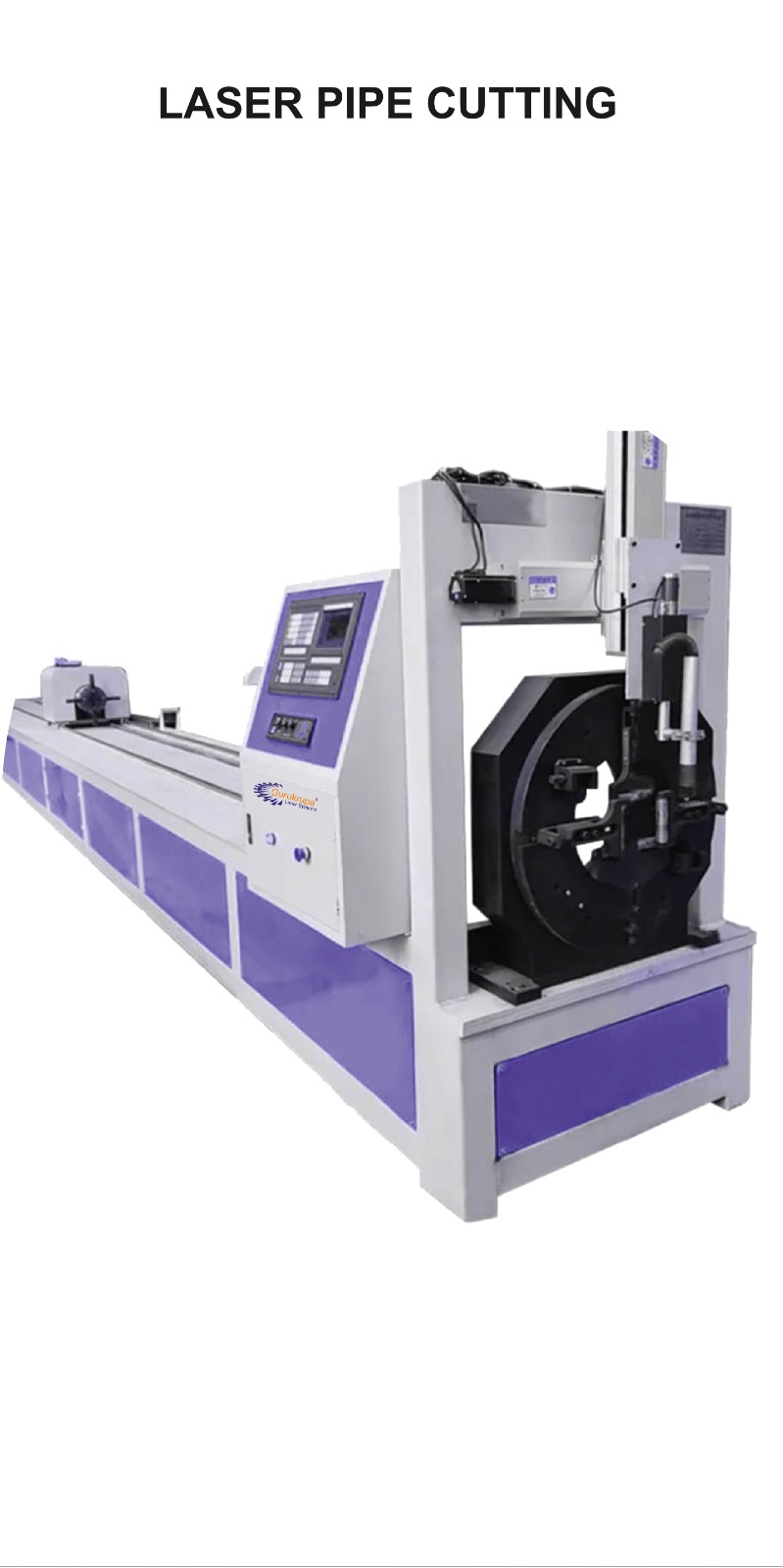
Laser Pipe Cutting Machine
Laser pipe cutting is a precision manufacturing process that uses a high-powered laser to cut or shape metal pipes and tubes. Unlike traditional mechanical cutting methods, laser cutting offers speed, accuracy, and the ability to create complex shapes without the need for additional tools or dies. Here's a breakdown of key aspects:
How It Works
Laser Source – Commonly uses fiber lasers or CO₂ lasers.
Focusing – The laser beam is focused onto the surface of the pipe.
Cutting Process – The intense heat melts, burns, or vaporizes the metal, and a gas (like oxygen or nitrogen) blows away the molten material.
CNC Control – Computer Numerical Control (CNC) machines rotate and position the pipe to cut precise angles, patterns, or shapes.
Advantages
High Precision – Can achieve very tight tolerances and smooth edges.
Flexibility – Able to cut complex geometries, holes, or angled ends.
Non-contact Cutting – Reduces mechanical stress and deformation.
High Speed – Faster than conventional cutting for many pipe diameters.
Applications
Automotive industry (exhausts, chassis components)
Aerospace (tubing for hydraulic and fuel systems)
Furniture and structural metal fabrication
Oil and gas pipelines
Considerations
Material thickness: Laser cutting is most effective on thin to medium-thick metal pipes; very thick pipes may require multiple passes or alternative methods.
Pipe diameter: Machines are designed to accommodate specific ranges of pipe sizes.
Edge finishing: Some applications may require additional polishing after cutting.
©2026. All Rights Reserved.
Gurpukrura is proudly powered by WordPress